
A commercial renovation is a fundamentally different undertaking than a residential one. It is not driven by personal taste or the desire for a sanctuary; it is a strategic business decision governed by return on investment, operational efficiency, and brand identity. The goal is to manipulate the physical environment to achieve a specific commercial objective—whether to attract higher-paying tenants, increase retail sales, improve employee productivity, or ensure regulatory compliance. This process is a complex calculus where architecture meets asset management, and every decision, from the flooring underfoot to the HVAC system overhead, is evaluated through a lens of financial and functional performance. The successful commercial renovation is not merely an update; it is a recalibration of a business tool, an intentional intervention designed to enhance the value of the enterprise it houses.
Defining the Drivers: Why Businesses Undertake Renovations
The impetus for a commercial renovation project falls into several distinct, often overlapping, categories. Understanding this primary driver is the first step in shaping the project’s scope and budget.
Tenant Improvement (TI): This is the most common form of commercial renovation. A landlord performs or funds improvements to a raw or previously occupied space to make it suitable for a specific tenant. TI allowances are a standard part of commercial leases, and the negotiation over their amount and scope is a critical part of the leasing process. The landlord’s goal is to secure a stable, long-term tenant with minimal capital outlay, while the tenant’s goal is to create a space that supports their business operations without exceeding their allocated allowance.
Brand Alignment and Customer Experience: For consumer-facing businesses like retail stores, restaurants, and hotels, the physical space is a direct extension of the brand. A renovation in this context is a marketing investment. It is about creating an environment that reinforces brand values, controls the customer journey, and encourages specific behaviors—like longer dwell times in a cafe or increased basket size in a retail store. The aesthetics are not arbitrary; they are a carefully crafted tool to shape perception and drive revenue.
Operational Efficiency and Modernization: Many renovations are inward-focused, aimed at improving the internal workings of a business. This can involve reconfiguring an office floor plan to support hybrid work and collaboration, upgrading a manufacturing facility’s lighting to LED for energy savings and better visibility, or retrofitting a warehouse with new technology. The return is measured in reduced utility costs, lower labor expenses, fewer errors, and increased output.
Maintenance, Deferred Maintenance, and Code Compliance: This is the least glamorous but most critical driver. All building systems have a finite lifespan. A renovation may be necessary to replace a failing roof, update an obsolete electrical panel, or bring a property into compliance with new building codes or accessibility standards (ADA). While these projects offer no visible “wow” factor, they are essential for the safety, legality, and long-term viability of the asset.
The Unique Complexities of the Commercial Realm
The commercial renovation landscape is fraught with challenges that are either absent or minimized in residential work. Navigating these complexities requires specialized expertise and meticulous planning.
Regulatory Hurdles and Permitting: Commercial projects face a much higher level of scrutiny from municipal authorities. The permitting process is often longer and more expensive, requiring detailed architectural and engineering drawings, energy compliance calculations, and strict adherence to a more complex web of International Building Codes (IBC), fire codes, and accessibility guidelines (ADA). A simple oversight in the planning phase can lead to costly delays and redesigns during inspection.
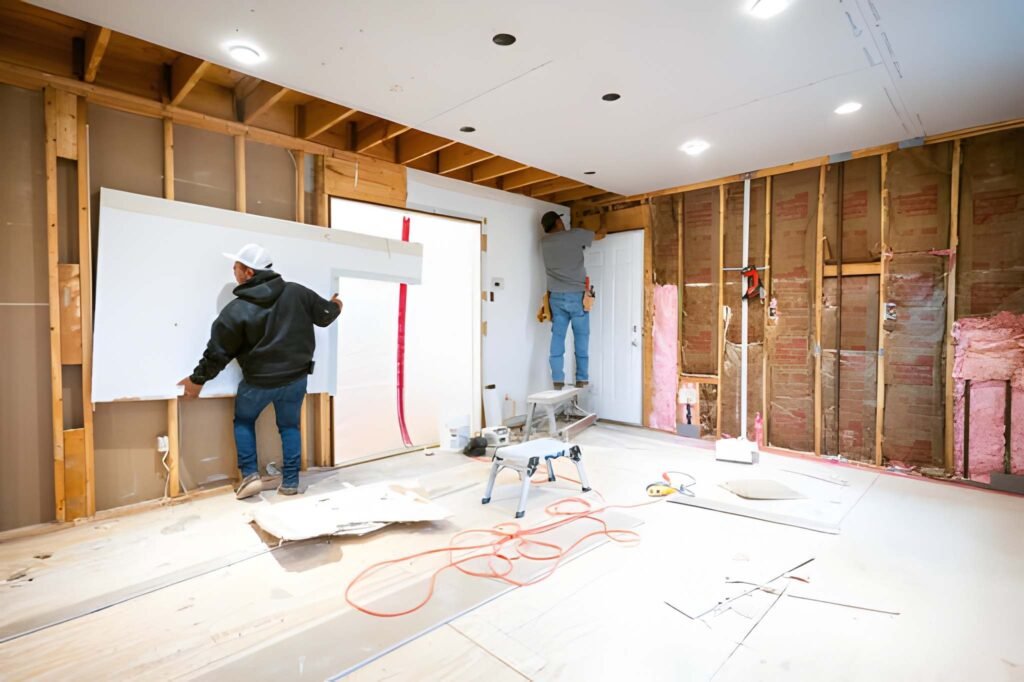
The Phased Occupancy Imperative: Unlike a homeowner who can vacate during a renovation, most businesses must remain operational. This demands a phased construction plan that minimizes disruption to daily activities. Construction must often occur after hours, on weekends, or in sealed-off sections of the building. This “occupied renovation” requires sophisticated logistics, enhanced safety protocols, and constant communication between the contractor and the business owner to protect both employees and customers from noise, dust, and safety hazards.
The Decision-Making Matrix: A residential renovation typically has one or two decision-makers. A commercial project involves a committee. This can include the business owner, a facilities manager, a brand manager, a CFO scrutinizing the budget, and potentially a landlord or a corporate real estate team. This diffusion of authority can slow decision-making and create competing priorities that the project manager must constantly balance.
Material and System Specifications: The materials used in a commercial setting are subject to far more demanding performance criteria. Flooring must withstand hundreds of people walking on it daily, not a family of four. Furniture must meet flammability codes and durability standards. Electrical and mechanical systems are larger, more complex, and must be designed for continuous operation. The selection is less about aesthetics and more about lifecycle cost, maintenance schedules, and warranty specifications.
A Strategic Framework for Project Types
Commercial renovations can be segmented by both the type of space and the scale of the intervention.
Category 1: Office Spaces
The modern office renovation is dominated by the shift toward hybrid work and collaborative culture.
- The Open-Plan Reconfiguration: Moving away from walled offices to open layouts with benching stations, supported by a variety of collaboration spaces, phone booths, and focus rooms.
- Technology Integration: The core infrastructure now includes robust WiFi, enhanced video conferencing capabilities in every meeting room, and power access throughout for a mobile workforce.
- Amenity Spaces: To attract and retain talent, offices are incorporating high-quality break rooms, coffee bars, fitness centers, and lounge areas that function as secondary workspaces.
Category 2: Retail Environments
In the age of e-commerce, the physical store must offer an experience that cannot be replicated online.
- Experiential Design: The layout is choreographed to tell a story and engage the senses, using lighting, music, and materiality to create a memorable brand immersion.
- Flexible Fixturing: Retailers need adaptable systems that can be easily reconfigured for new product launches, seasonal changes, or pop-up events.
- Seamless Omnichannel Integration: The space must physically support services like buy-online-pickup-in-store (BOPIS), in-store returns for online orders, and interactive digital kiosks.
Category 3: Food and Beverage (Restaurants, Cafes)
These are some of the most technically complex and brand-sensitive renovations.
- Front-of-House / Back-of-House Balance: The design must create an inviting atmosphere for guests while supporting the high-performance, safety-critical, and space-efficient demands of the kitchen.
- Brand-Themed Aesthetics: Every design element, from the chair fabric to the menu board font, is a deliberate brand signal.
- Infrastructure Upgrades: Often involves major investments in commercial-grade ventilation (hoods), grease traps, plumbing, and electrical systems to support specialized cooking equipment.
Category 4: Industrial and Warehouse Spaces
The driver here is pure efficiency and functionality.
- Flow Optimization: Renovations focus on reconfiguring storage racking, dock doors, and internal traffic patterns to speed up the receiving, storage, and shipping processes.
- System Modernization: This includes upgrading to motion-sensor LED lighting, installing energy-efficient HVAC for climate-controlled storage, and reinforcing floors to support heavier automation like robotic pickers.
- Employee Facilities: Improving break rooms, locker rooms, and office pods within the warehouse to enhance worker satisfaction and safety.
The Financial and Project Management Ecosystem
The financial structure of a commercial renovation is distinct from its residential counterpart.
The Budget and the TI Allowance: The budget is not a single number but a detailed pro forma. For tenant improvements, it is directly tied to the TI allowance negotiated in the lease—a fixed dollar amount per square foot provided by the landlord to the tenant for build-out. Any costs exceeding this allowance are the tenant’s responsibility. This creates a constant tension between the desired design and the hard cap of the allowance.
The Professional Team: The team is larger and more specialized.
- Commercial Architect/Designer: Creates the construction documents and navigates the permitting process.
- General Contractor (GC): Manages the project, but in the commercial world, the GC’s contract is a far more complex document, often a fixed-price or Guaranteed Maximum Price (GMP) agreement with detailed schedules of values.
- Engineers: Structural, mechanical (HVAC), and electrical engineers are almost always involved to sign off on systems.
- Project Manager (for the Tenant/Owner): Often an internal hire or a consultant who represents the business’s interests, manages the budget, and approves change orders.
The Critical Path and Phasing: The project schedule, or “critical path,” is the holy grail. It is a detailed timeline that sequences every task, from demolition to punch list, and identifies the dependencies between them. For an occupied renovation, this schedule is broken into phases, with clear milestones for temporarily relocating staff or closing sections of a store. Contingency planning is not just for unforeseen construction issues but also for business disruption.
A successful commercial renovation is a testament to strategic planning and disciplined execution. It requires a deep understanding of not just construction, but of business operations, finance, and human behavior. When done correctly, the renovated space ceases to be a mere container for business activity and becomes an active, dynamic asset that drives growth, fosters culture, and secures a competitive advantage in an ever-evolving marketplace. The dust and disruption are temporary; the strategic payoff is what endures.