Vinyl flooring has undergone a quiet revolution. It has transcended its dated reputation of thin, glossy sheets to become a dominant force in residential design, celebrated for its durability, water resistance, and startling realism. For homeowners and investors navigating a renovation, affordable vinyl represents the sweet spot where budget-conscious practicality meets ambitious aesthetic goals. The term “affordable” itself requires definition—it is not about finding the cheapest product, but about identifying the flooring that delivers the highest value, longevity, and style for a modest investment. The best options balance cost per square foot with performance characteristics that prevent costly repairs or premature replacement, making them not just inexpensive, but genuinely economical over the life of the floor.
Understanding the Vinyl Flooring Landscape: Types and Constructions
The world of vinyl flooring is not a monolith. It is a category divided into distinct types, each with its own manufacturing process, installation method, and price point. Understanding this hierarchy is the first step to making an intelligent choice.
Luxury Vinyl Plank (LVP) is engineered to replicate hardwood. It comes in long, narrow strips, complete with realistic embossed textures and beveled edges that mimic individual wood planks. Its primary appeal lies in its ability to provide the warm, timeless look of wood in areas where solid hardwood would be impractical, such as basements, bathrooms, and kitchens.
Luxury Vinyl Tile (LVT) follows the same principle but is designed to imitate stone or ceramic tile. LVT comes in square tiles, often with grout-able options, providing the cool, elegant aesthetic of stone without the cold feel underfoot, the high cost, or the difficult installation.
The construction of these products is what dictates their quality and price. There are two primary formats:
Glue-Down Vinyl: This is a traditional product where individual tiles or planks are adhered directly to the subfloor with a special adhesive. It creates a very stable, permanent floor that will not shift or expand. However, installation is more labor-intensive and messy, and any damage to a single plank requires careful removal.
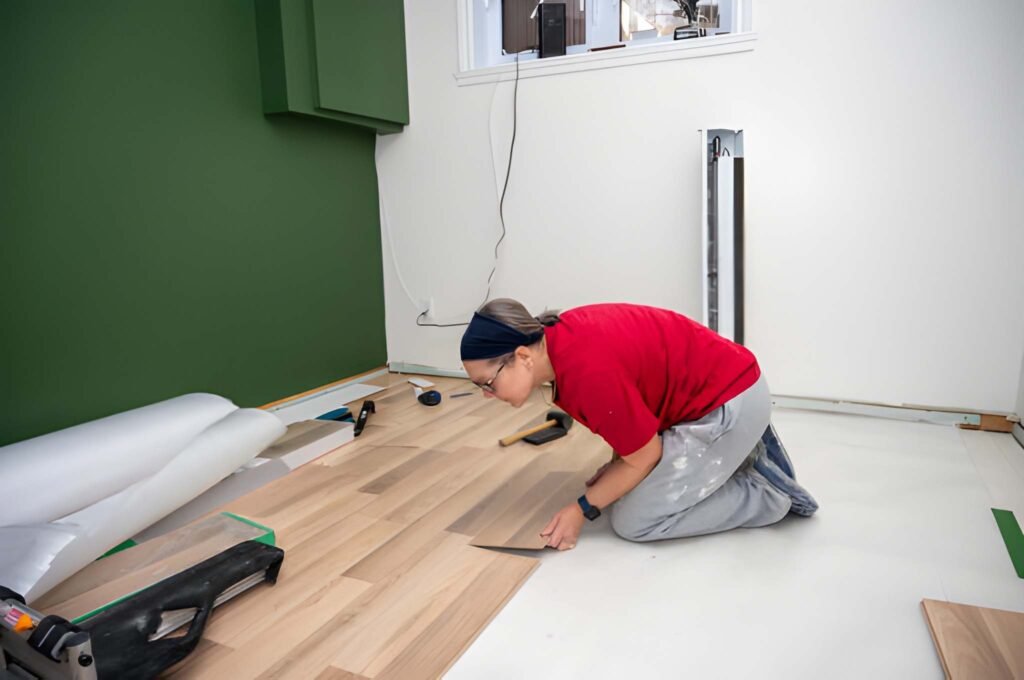
Click-Lock or Floating Floor Vinyl: This is the modern, DIY-friendly champion. LVP and LVT with a click-lock system feature interlocking edges that snap together over an underlayment, forming a single “floating” sheet that is not attached to the subfloor. Installation is faster, cleaner, and requires fewer specialized tools. It also allows for easier replacement of damaged planks.
Within these formats, the build quality is defined by layers. A quality affordable vinyl floor will have a clear wear layer (the thicker, the better), a printed design layer with its high-resolution photograph, a solid vinyl core that provides stability, and often an attached underlayment for sound absorption and comfort.
The Top Contenders: A Breakdown of Affordable Vinyl Choices
When evaluating affordability, we consider products that generally fall below the $3.50 to $4.00 per square foot threshold, while still offering reliable performance for residential use.
Luxury Vinyl Plank (LVP) with a Rigid Core: This is the undisputed leader in the affordable category. Rigid core LVP, which includes products known as WPC (Wood Plastic Composite) or SPC (Stone Plastic Composite), represents the peak of value engineering.
- SPC (Stone Plastic Composite): For most homes, SPC is the recommended choice. Its core is a dense, limestone-polymer composite. This makes it exceptionally rigid, durable, and resistant to indentation from furniture legs. SPC is also highly stable, meaning it expands and contracts very little with temperature fluctuations, making it ideal for installations over concrete subfloors or in rooms with large windows and sun exposure. It feels solid underfoot and produces a satisfying “click” when walked on, devoid of the hollow sound of cheaper products.
- WPC (Wood Plastic Composite): WPC has a core that incorporates expanded foam, making it slightly softer and more forgiving underfoot than SPC. This can be a benefit in kitchens where you stand for long periods. However, it is generally less dense than SPC and can be more susceptible to indentation. It often comes at a slightly higher price point for similar visual quality.
The affordability of rigid core LVP comes from mass production and competition. Brands like Coretec, Lifeproof (The Home Depot), and SmartCore (Lowe’s) have driven innovation and lowered prices, offering products with 20-mil wear layers and convincing wood visuals for between $2.50 and $3.50 per square foot.
Sheet Vinyl (LVT): Do not dismiss sheet vinyl. Modern sheet goods are a far cry from the dated patterns of the past. They now feature sophisticated, in-register embossing that replicates the texture of wood grain or stone, and they come in rolls that are often 6 or 12 feet wide.
- The Primary Advantage: The minimal number of seams. In a bathroom, laundry room, or kitchen, a single sheet of vinyl means there are virtually no seams for water to penetrate. This makes it arguably the most water-resistant option available.
- Cost and Installation: Sheet vinyl is typically the least expensive option in terms of material cost, often ranging from $1.00 to $2.50 per square foot. However, installation is a professional skill. The material is cumbersome, requires precise cutting, and must be seamed with heat welding for a truly waterproof seal. A DIY mistake with sheet vinyl can be costly.
Peel-and-Stick Vinyl Tiles: This is the budget option with clear limitations. These tiles have a pre-applied adhesive backing and are simply pressed into place.
- Appropriate Use Cases: They are best suited for very small, low-traffic areas like a half-bath, a closet, or a craft room where a quick, temporary update is desired.
- The Drawbacks: The adhesive can fail over time, especially with temperature changes or moisture exposure. The tiles are thin and can show every imperfection in the subfloor. The overall feel is cheap, and the long-term value is low. For any primary living space, it is a false economy.
Comparative Analysis: Choosing the Right Type for Your Home
The following table provides a direct comparison to guide the selection process based on key homeowner priorities.
| Feature | Rigid Core LVP (SPC) | Sheet Vinyl | Peel-and-Stick Tiles |
|---|---|---|---|
| Cost per Sq Ft (Material) | $2.50 – $4.00 | $1.00 – $2.50 | $0.50 – $2.00 |
| DIY Installation Difficulty | Easy to Moderate | Difficult | Very Easy |
| Water Resistance | Excellent (fully waterproof) | Superior (fewest seams) | Good (seams are vulnerable) |
| Durability & Indentation Resistance | Excellent (especially SPC) | Good | Poor |
| Comfort & Sound Underfoot | Good (with attached pad) | Fair (can feel thin) | Poor (feels thin) |
| Best Suited For | Entire main floors, basements, kitchens | Bathrooms, laundry rooms, kitchens | Low-traffic areas, rentals, temporary fixes |
| Overall Value Proposition | Highest long-term value for most homes | Best for absolute waterproofing in wet areas | Lowest upfront cost, lowest longevity |
Key Selection Criteria Beyond Price
Once you have narrowed the type, several technical specifications demand your attention. These determine how the floor will perform and feel for years to come.
Wear Layer Thickness: This is the clear, protective urethane coating on top of the design layer. It is the single most important factor for longevity. For affordable residential use, aim for a wear layer of 12 mil to 20 mil. This will handle the foot traffic of an average family, resist scratches from pets, and be cleanable without damaging the design. A wear layer below 12 mil is suitable only for very light use, like a closet. Beware of products that only list the “overall” thickness of the plank; the wear layer is what matters most.
The Underlayment: A quality attached underlayment is a significant upgrade. It provides a moisture barrier, reduces sound transmission (both from footfalls and to the room below), and adds comfort underfoot. Many affordable rigid core LVP products now include a pre-attached foam underlayment, eliminating the need and cost of buying a separate roll. If the product you choose does not have one, factoring in the cost and labor of a separate underlayment is essential.
Visual Realism: Affordable does not have to mean cheap-looking. Examine the sample closely. The best affordable options use high-definition printing and, crucially, embossed-in-register (EIR) texturing. This means the raised grain texture aligns perfectly with the wood grain image underneath, creating a floor that looks and feels like real wood. Avoid products with a flat, glossy, or repeating pattern, as these will quickly betray their synthetic nature.
Strategic Installation and Long-Term Value
Even the best affordable vinyl floor can be undermined by a poor installation. For click-lock LVP, the subfloor must be clean, dry, and remarkably level—typically no more than 3/16 of an inch deviation over a 10-foot span. Any significant dips or humps will cause the locking systems to fail over time, creating gaps and a spongy feel. Proper acclimation of the planks to the room’s temperature and humidity for at least 48 hours is a non-negotiable step that prevents expansion or contraction after installation.
The long-term value of an affordable vinyl floor is immense. Its 100% waterproof nature prevents the catastrophic damage that can occur with laminate or hardwood from a spilled appliance or a plumbing leak. Its durability means it will not need to be refinished or replaced for many years, assuming a quality wear layer was selected. From a real estate perspective, a well-installed, modern LVP floor in a neutral wood or stone look is a significant selling point, appealing to buyers who value low-maintenance, durable materials. It is an investment that protects the homeowner from future costs while providing immediate daily satisfaction—the very definition of true affordability.