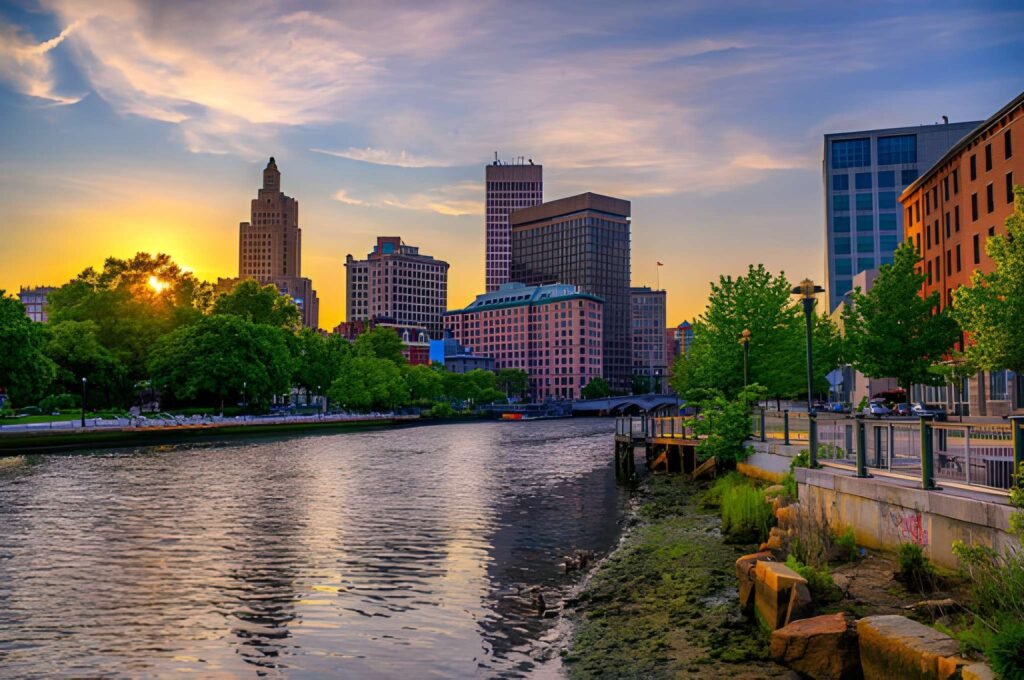
Providence is a city that thrives on its contrasts. It is a place where Ivy League ambition meets old-world Italian grit, where cutting-edge art and design are forged in a post-industrial landscape, and where a small-town feel is packed into a dense, historic New England capital. Living in Providence means embracing a city of immense creative energy, profound affordability for the Northeast, and a distinct identity that proudly exists in the shadow of its larger Boston neighbor. This guide moves beyond the WaterFire events to examine the intricate realities of life in the Creative Capital, from its world-renowned design schools to its challenging economy, providing a clear-eyed view of what it truly means to build a life in this unique and resilient city.
The Providence Vibe: Life in the Creative Capital
Life in Providence is defined by its human scale, its deep history, and its defiant creativity. The pace is slower than in Boston or New York; there’s time for a long coffee, a walk down Benefit Street’s Mile of History, or an impromptu gallery opening. The vibe is unpretentious, artistic, and fiercely independent. It’s a city of students (with over 30,000 in its downtown core), artists, chefs, and lifelong residents whose families have been here for generations. The energy is one of making do and making art—a DIY ethos born from the city’s post-industrial decline and subsequent renaissance. The cultural fabric is deeply influenced by its Italian, Irish, Portuguese, and Cape Verdean communities, visible in its Federal Hill restaurants and vibrant neighborhood festivals. It’s a city that feels both undiscovered and deeply established.
The Northeast Value: Cost of Living
Providence’s most powerful asset is its affordability relative to the rest of the Northeast Corridor. It offers a genuine, historic urban experience at a fraction of the cost of Boston or New York.
A detailed budget for a single professional living in a one-bedroom apartment in a popular area like the East Side or West End might look like this:
- Rent: $1,500 (for a 600-700 sq ft apartment)
- Utilities (Electricity, Gas, Internet): $200
- Groceries: $380
- Dining & Entertainment: $450 (a phenomenal and affordable food scene)
- Transportation (Many walk/bike; car costs estimated): $400
- Miscellaneous: $250
This creates a baseline monthly expenditure of approximately $3,180. To afford this comfortably (using the standard guideline that rent should not exceed 30% of gross income), your pre-tax annual income would need to be at least $60,000.
This calculation is shown as:
\text{Required Annual Income} = \frac{\$1,500 \times 12}{0.3} = \$60,000This accessibility is a primary driver attracting artists, students, and remote workers priced out of Boston.
A City of Villages: Best Neighborhoods
Providence is a collection of distinct, village-like neighborhoods, each with a strong identity.
- East Side: The historic, affluent, and academic heart of the city. Includes College Hill (home to Brown University and RISD, with stunning colonial architecture), Fox Point (a mix of students, Portuguese families, and young professionals), and Blackstone (home to Swan Point Cemetery and beautiful parks). Expensive but beautiful.
- Downtown: The urban core, which has seen a residential renaissance. Includes Downcity (loft apartments, the Providence Place mall, and Trinity Rep theater) and the Financial District.
- West Side / Federal Hill: Federal Hill is the city’s historic Italian neighborhood, centered on Atwells Avenue with incredible restaurants, cafes, and markets. The broader West End is a diverse, rapidly gentrifying area known for its artist communities, hip restaurants, and historic housing stock.
- South Side: A large, diverse area encompassing several neighborhoods. Includes Elmhurst (residential, near Providence College), Upper South Providence, and Washington Park. Offers more affordable housing and strong cultural communities.
- Smith Hill: Located north of downtown, home to the State House and a mix of government workers, families, and students. More affordable and centrally located.
- Jewelry District: A former industrial area south of downtown now transforming into a hub for life sciences, tech companies, and new apartment buildings, spurred by Brown University’s investments.
The New England Calculation: Renting vs. Buying
The decision to rent or buy in Providence is one of the most compelling in the Northeast, thanks to a stable market of relatively affordable historic homes.
Renting offers flexibility to explore different neighborhoods and is a low-commitment way to experience the city. The rental market is competitive, especially in areas popular with students.
Buying is a strong and achievable long-term wealth-building strategy. The barrier to entry is low compared to other New England cities. A 20% down payment on a median-priced Providence home is a realistic goal for many professionals. The city is full of beautiful, historic multi-family homes that can help offset mortgage costs through rental income.
The financial break-even point is typically 5-7 years. A simplified formula illustrates the calculation:
\text{Break-Even Point (years)} = \frac{\text{Total Upfront Costs}}{\text{Annual Rent} - (\text{Annual Mortgage Interest} + \text{Annual Property Taxes} + \text{Annual Insurance} + \text{Annual Maintenance})}Upfront costs include down payment and closing costs. The high property tax rate in Rhode Island is a critical factor to consider.
The Eds and Meds Economy: Job Market and Career Opportunities
Providence’s economy is anchored by the “Eds and Meds” sector—Education and Medicine—which provides stability but can limit high-paying opportunities outside these fields.
- Education & Research: The undisputed core. Brown University (Ivy League) and the Rhode Island School of Design (RISD) are world-renowned institutions and major employers. Johnson & Wales University is a leader in culinary arts and hospitality.
- Healthcare: A massive employer. Lifespan (Rhode Island Hospital, The Miriam Hospital) and Care New England are the two major healthcare systems that dominate the sector.
- Government: As the state capital, government administration is a significant source of employment.
- Technology & Entrepreneurship: A small but growing sector, often spun out from the universities. The Jewelry District is becoming a focal point for tech and bio-tech startups.
- Hospitality & Culinary Arts: A strong sector driven by the city’s incredible food scene and JWU’s influence, though often with lower wages.
Educational Landscape: Best Schools and Universities
Providence Public Schools face significant challenges, leading to high demand for charter schools and magnet programs. The perception of school quality is the primary driver of movement to the suburbs.
For higher education, Providence is an elite global destination:
- Brown University: An Ivy League university known for its open curriculum and rigorous academics.
- Rhode Island School of Design (RISD): One of the world’s premier art and design colleges.
- Johnson & Wales University: A private university renowned for its culinary, hospitality, and business programs.
- Providence College: A private Catholic liberal arts university.
- University of Rhode Island has its nursing and other satellite programs in the city.
Getting Around: Transportation and Reality
Providence is one of the most walkable and bikeable small cities in the U.S. Its dense, historic core makes it easy to live without a car, especially on the East Side and Downtown. The Rhode Island Public Transit Authority (RIPTA) provides comprehensive bus service throughout the city and state. The city’s greatest transportation asset is Amtrak’s Northeast Corridor line, with Providence Station offering frequent, high-speed service to Boston (45 mins) and New York City (3 hours). A car is useful for trips to the beaches or grocery stores but is not a daily necessity for many urban dwellers.
The Housing Market: A Tactical Overview
The Providence housing market is hot for a city its size, characterized by high demand for a limited inventory of historic homes.
- Average Home Prices: As of late 2023, the median sale price for a home in Providence is approximately $410,000. This figure includes multi-family homes, which are very common.
- Most Affordable Areas to Buy a Home: Look to the South Side (Olneyville, Hartford), Smith Hill, and Charles neighborhoods. These areas offer significant value but may have longer-term investment horizons.
- Luxury Real Estate Hotspots: College Hill is the historic epicenter of luxury, with multi-million dollar colonial homes. Blackstone Boulevard and Wayland Square are also premier addresses. New construction in the Jewelry District commands premium prices.
- Rental Market: Competitive, especially in areas popular with students (College Hill, Fox Point). Landlords typically require proof of income and first/last/security upfront.
- Best Places to Invest & Future Growth Neighborhoods: Investment follows the West Side. Olneyville, Valley, and parts of Upper South Providence are seen as having strong potential for appreciation as the downtown and Federal Hill areas become saturated.
The Cultural Repertoire: Things to Do
| Activity Category | Iconic Examples | Hidden Gems |
|---|---|---|
| Cultural Attractions | Rhode Island School of Design Museum (RISD Museum), Providence Performing Arts Center (PPAC), WaterFire Providence | The Arcade (oldest indoor mall in US), Culinary Archives & Museum at JWU, Providence Children’s Museum |
| Parks & Outdoors | Roger Williams Park (zoo, botanical center, museum), Blackstone Boulevard, Benefit Street’s “Mile of History” | Swan Point Cemetery, India Point Park, Neutaconkanut Hill |
| Food & Drink | Italian on Federal Hill, Seafood, Del’s Lemonade, Coffee Milk | Al Forno (invented grilled pizza), North Bakery (Azorean), New York System Wieners (a RI classic) |
| Nightlife | Bars on Westminster St, G Pub, The Avery | AS220 (artist-run space), The Parlour (cocktails), The Scurvy Dog (dive bar) |
Annual Festivals and Events: WaterFire (art installation with bonfires on the river), PVDFest (a multi-day arts festival), Federal Hill Stroll, and Bright Night Providence (New Year’s Eve celebration).
Shopping: From the indie boutiques of Westminster Street and Wayland Square to the massive Providence Place mall.
Quality of Life & Relocation Essentials
- Raising a Family: Challenging within the city limits due to the public school system. Many families who stay navigate the charter/magnet system or opt for private schools. The East Side has more viable public school options.
- Crime and Safety: Property crime is the most common issue. Violent crime is concentrated in specific, economically disadvantaged areas. Researching specific neighborhoods is crucial.
- Healthcare and Hospitals: High-quality healthcare is available through the Lifespan system, which includes Rhode Island Hospital (a Level I trauma center) and The Miriam Hospital.
- Weather and Climate: A humid continental climate. Summers are warm and humid. Winters are cold, gray, and can bring significant snow and nor’easters. Spring and fall are beautiful but short.
- Cost of Utilities: For a 1,200 sq ft apartment, average monthly costs are:
- Electricity (RI Energy): $120 – $180
- Gas (RI Energy): $150 – $250 (in winter)
- Water/Sewer: $80 – $100
- Internet: $70 – $100
The Relocation Checklist
- Secure Employment: Have a job lined up. The local job market can be challenging outside of eds and meds.
- Choose Your Neighborhood Wisely: Providence is a city of micro-neighborhoods. Visit at different times of day. The difference of a few blocks can be significant.
- Consider a Car Optional Lifestyle: If you live and work on the East Side or Downtown, you can easily live without a car, saving significant money.
- Embrace the Culture: Go to a WaterFire, eat on Federal Hill, and learn the difference between a cabinet and a frappe.
- Prepare for Winter: Invest in a good winter coat and boots. Snow removal is a fact of life.
The Final Verdict: Pros and Cons of Living in Providence
Pros:
- An affordable cost of living for a historic New England city.
- A world-class arts, culture, and food scene driven by its universities.
- A highly walkable, human-scale urban environment with incredible architecture.
- Easy access to Boston and New York via Amtrak, and to beautiful beaches.
- A strong, authentic sense of community and a thriving creative class.
Cons:
- A challenging job market that is overly reliant on a few sectors (eds and meds).
- A struggling public school system within the city limits.
- High taxes (property and state income tax).
- Winters can be long, gray, and harsh.
- The city’s small size can feel limiting for career advancement in certain industries.
Living in Providence is a choice to prioritize creativity, community, and quality of life over high salaries and corporate career ladders. It is a city for artists, academics, foodies, and those who appreciate historic beauty and a slower pace. For those who can find their niche in its economy, it offers a deeply rewarding, authentic, and sustainable urban lifestyle that is increasingly rare in the modern world. It is the perfect city for those who want the intellectual and cultural stimulation of a college town with the grit and authenticity of a historic urban center.