The garage stands as a unique paradox in the American household. It is often the single largest unused square footage in the home, yet it consistently becomes a chaotic repository for everything we cannot bear to discard. It is a space of immense potential, trapped between its original function as a shelter for vehicles and its reality as a no-man’s-land of clutter. A garage renovation is not merely an organizational project; it is a reclamation of territory. It is a deliberate process of transforming this underutilized, often neglected space into a functional, efficient, and purposeful extension of the living environment. This transformation requires a strategic blend of brutal honesty about the space’s current state and a visionary approach to its latent possibilities.
The Strategic Imperative: Defining a New Purpose
The first and most critical step in a garage renovation is to move beyond the vague desire for a “clean garage” and instead define a clear, primary function. This decision will dictate every subsequent choice, from storage solutions to flooring and lighting. The garage can no longer be a catch-all; it must be assigned a mission.
The most common strategic paths include:
- The Pristine Vehicle Haven: The primary goal is to restore the garage to its intended purpose, creating a clean, safe, and dignified space for vehicles. This path prioritizes maximum floor space, durable and easy-to-clean surfaces, and protection from the elements.
- The Workshop & Maker Space: This transforms the garage into a center for productivity and hobbies. The focus shifts to robust work surfaces, abundant, accessible tool storage, and specialized utility requirements like enhanced power and lighting.
- The Hybrid Hub: This is the most common and practical approach, creating a multi-functional space that accommodates parking, storage, and a secondary activity like a home gym, a laundry center, or a potting bench. This requires the most sophisticated zoning and organizational planning.
- The Ultimate Organizational Machine: For families overwhelmed by sports equipment, holiday decorations, and bulk purchases, the renovation is an exercise in hyper-efficiency. This path is dominated by high-density storage systems and a ruthless commitment to a place for everything.
This initial strategic declaration is non-negotiable. Attempting to be all things without a clear hierarchy leads to a renovated space that quickly reverts to its former chaos.
The Foundational Overhaul: Addressing the Unseen
Before a single storage bin is purchased, the garage must be addressed at its shell. This is the unglamorous but essential work that separates a lasting transformation from a superficial one.
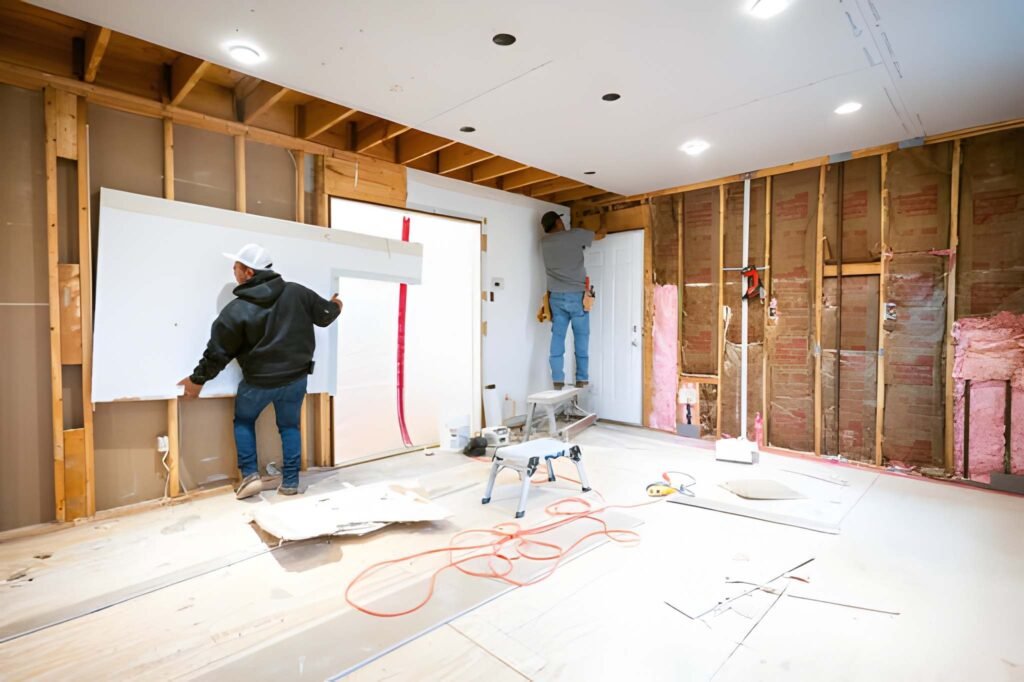
The Envelope: Walls, Floor, and Ceiling. Most garages are built with unfinished walls—exposed studs that collect dust and create a perpetually unfinished feel. Insulating and drywalling the walls is the single most impactful upgrade. It cleanly finishes the space, provides a thermal and acoustic barrier, and creates a solid, paintable surface for storage systems and organization. The ceiling, often open to the roof trusses, is a vortex of dust and lost heat. Sealing it with drywall or panels completes the “room” feel and dramatically improves light reflection.
The concrete floor is typically stained, cracked, and porous. A professional-grade epoxy floor coating or the installation of interlocking polyvinyl tiles transforms this surface. These coatings create a seamless, durable, and chemical-resistant finish that is easy to clean and visually cohesive. It elevates the space from a utilitarian slab to a finished floor.
The Utility Core: Power, Lighting, and Climate. The standard garage offers a single, inconvenient outlet and one dim light bulb. A modern garage requires a strategic utility upgrade.
- Lighting: Replace a single bulb with a grid of LED shop lights. These fixtures provide bright, shadowless, and energy-efficient illumination, which is critical for both detailed work and general safety. Lighting should be zoned, with separate switches for general areas and task zones like a workbench.
- Electrical: A new dedicated subpanel may be necessary to support additional circuits. Install numerous GFCI-protected outlets around the perimeter, ensuring they are accessible above workbench height. Consider dedicated 240-volt outlets for an electric vehicle charger or a welder, and 20-amp circuits for power tools.
- Climate: While full climate control is a luxury, a minimal system is often a necessity. A properly insulated garage can be tempered with a simple mini-split heat pump, which provides both heating and cooling. As a baseline, a ventilation fan is crucial for expelling fumes and moisture.
The Architecture of Organization: Systematic Storage Solutions
With a solid, clean shell in place, the architecture of organization can be implemented. This is where the defined purpose dictates the design.
The Vertical Frontier. The key to a functional garage is to reclaim the floor by exploiting the vertical space of the walls. The gold standard for this is a fully integrated slatwall or track-based panel system. These systems, typically made of high-density polyethylene or powder-coated steel, are installed across the wall surfaces. They accept a universe of compatible hooks, bins, shelves, and brackets. This creates a fully customizable and reconfigurable storage landscape. Bicycles hang vertically, shovels and rakes are secured off the floor, and shelves for bins can be adjusted as needs change. This system eliminates the need for a jumble of freestanding shelving units that consume precious floor space.
The Overhead Domain. The space between the ceiling joists or trusses is valuable real estate for items used seasonally or infrequently. Sturdy overhead storage racks, securely mounted to the ceiling structure, provide a home for holiday decorations, luggage, and spare parts. This clears a significant volume of clutter from the main area below.
The Workstation. For the workshop or hybrid hub, a dedicated workbench is the command center. This should not be a rickety table but a solid, anchored core. The ideal bench has a thick wood or laminate top, integrated vises or tool mounts, and storage beneath for frequently used tools. Its design should be specific to the primary tasks—lower for detailed work, higher for standing assembly.
The following table contrasts the before-and-after state of a garage organized with these principles:
| Zone | “Before” State | “After” State with Systematic Renovation |
|---|---|---|
| Floor Space | Cluttered with boxes, sports gear, and random items; difficult to walk through, let alone park a car. | Clear and open; primary function (parking, gym) is unobstructed. |
| Wall Space | Exposed studs with tools haphazardly hung or leaning; a chaotic visual field. | Finished walls with a slatwall/track system; every item has a designated, visible hook or shelf. |
| Overhead Space | Empty or filled with cobwebs and dust. | Utilized with sturdy racks holding labeled, plastic bins for seasonal items. |
| Utility | A single light bulb and one outlet; dark and inconvenient. | Bright, shadowless LED lighting and abundant, accessible outlets for tools and charging. |
The Final Layer: Security, Safety, and Finishing Touches
A renovated garage is an integral part of the home and must be treated as such. This includes upgrading the often-flimsy pedestrian door to a solid-core, secure model. The main garage door should be inspected and its automatic opener updated to a modern, quiet model with rolling-code security technology. Safety demands the installation of smoke detectors and a carbon monoxide detector, especially if the garage attaches to the house.
Finally, the aesthetic touches matter. A fresh coat of light-colored, semi-gloss paint on the walls reflects light and makes the space feel larger and cleaner. Defining zones with different colored paint or floor markings can psychologically separate the workshop from the parking area. The goal is to create a space that you are not just willing to enter, but one you are proud to show off.
A garage renovation is a profound act of reclamation. It is the process of taking control of the chaos and imposing order, of converting wasted potential into tangible utility. It moves the garage from the periphery of the home to its functional core, proving that the most valuable square footage you can add to your property may not require an addition at all—it may simply require the vision to see what is already there.