A single day cannot make you a professional interior designer, but it can fundamentally change how you see and shape your surroundings. This one-day intensive course is not about memorizing styles or following fleeting trends. It is an immersive workshop in the architecture of perception—a crash course in the foundational principles that separate a considered, harmonious space from a mere collection of furniture. We will move beyond the “what” of decoration and into the “why” of design, equipping you with a durable, actionable framework you can apply to any space, immediately.
Course Philosophy: Principles Over Prescription
The goal is to provide a mental toolkit, not a shopping list. You will learn how to think like a designer, making confident, intentional decisions based on a set of universal, timeless concepts.
The Curriculum: A Journey from Macro to Micro
MODULE 1: The Foundation – Spatial Alchemy (9:00 AM – 10:30 AM)
- Objective: Learn to diagnose your space and manipulate the perception of its dimensions.
- Key Concepts:
- The Psychology of Space: How color, light, and scale directly impact emotion and behavior.
- The Sightline Audit: How to map the visual pathways in a room to create a sense of flow and expansiveness.
- The Color & Light Duo:
- Color as a Spatial Tool: Using value (lightness/darkness) and temperature (warm/cool) to advance or recede walls, raise ceilings, and define zones.
- The Lighting Layer Cake: Deconstructing ambient (general), task (focused), and accent (dramatic) lighting. Learn why a single overhead light is the enemy of good design.
- The Scale & Proportion Imperative: How to choose furniture that fits the room’s volume, avoiding the “dollhouse” effect or a “crammed” feeling.
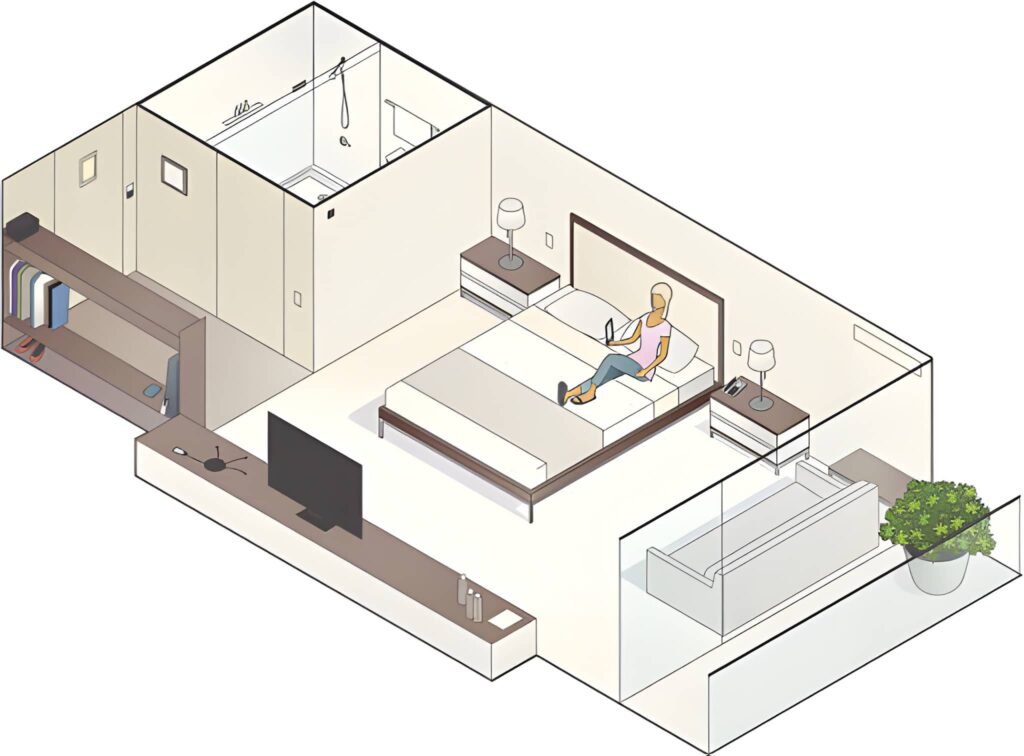
- Practical Exercise: Participants will be given floor plans and elevation drawings of a challenging space (e.g., a long, narrow room; a room with low ceilings). They will use the principles learned to develop a strategic plan to correct its flaws.
MODULE 2: The Blueprint – The Functional Floor Plan (10:45 AM – 12:15 PM)
- Objective: Master the art of arranging furniture to create intuitive, functional, and conversational layouts.
- Key Concepts:
- The Conversation Zone: How to arrange seating to foster natural interaction, with correct distances for intimacy and comfort.
- The Circulation Path: Ensuring clear, unobstructed walkways (a minimum of 36 inches wide).
- Focal Points: How to identify and enhance a room’s natural focal point (a fireplace, a view) or create one where none exists.
- Zoning: Using furniture and rugs to define separate areas for different activities (e.g., a reading nook within a living room) without building walls.
- Practical Exercise: Using scaled paper cutouts of furniture, participants will work in teams to create multiple effective floor plan solutions for a provided room layout, defending their choices based on the principles of circulation, conversation, and zoning.
MODULE 3: The Palette – A Cohesive Language of Color & Material (1:15 PM – 2:45 PM)
- Objective: Develop a cohesive and sophisticated color and material palette that tells a unified story.
- Key Concepts:
- The 60-30-10 Rule Demystified: A practical method for applying color with balance: 60% Dominant (walls, large sofa), 30% Secondary (rug, drapery), 10% Accent (pillows, art).
- The Power of a Monochromatic Scheme: Using texture and tone to create a rich, serene, and expansive environment.
- Materiality & Texture: Moving beyond color to incorporate wood, metal, glass, fabric, and stone. Learning how matte, glossy, rough, and smooth surfaces interact with light and each other to add depth.
- The “Chunk Base” Methodology: A sequential approach to building a room, starting with the largest, fixed elements (the foundational “chunk”) and layering upwards.
- Practical Exercise: Participants will be given a “foundational chunk” (e.g., a wood floor sample, a paint swatch) and a set of material samples. They will build a physical mood board that demonstrates a cohesive 60-30-10 application with intentional textural variation.
MODULE 4: The Curation – Styling with Intention (3:00 PM – 4:30 PM)
- Objective: Learn the art of finishing—how to place art, accessories, and lighting to create a polished, personal, and dynamic space.
- Key Concepts:
- The Art of the Wall: Principles for hanging art at the correct height, creating galleries, and using mirrors to amplify light and space.
- Styling Surfaces: Techniques for styling shelves, console tables, and coffee books using the principles of variation in height, shape, and texture. The “triangle” method for creating visual interest.
- The Final Layer – Plants & Life: The non-negotiable role of organic elements in softening a space and making it feel alive.
- Editing: The most important design skill of all. Learning when to stop and how to remove objects that do not serve the whole.
- Practical Exercise: Participants will be given a styled bookshelf image that is “off” and will work to diagnose the problems (e.g., lack of negative space, poor weight distribution, no color flow) and propose a restyled solution.
The Takeaway: Your New Design Lens
You will leave this course not with a certificate, but with a new way of seeing. You will walk into any room and instinctively assess its lighting layers, analyze its traffic flow, and deconstruct its color palette. You will possess the foundational confidence to tackle your own spaces, making deliberate choices that result in environments that are not just beautiful, but truly functional, harmonious, and reflective of a considered life. This is the power of understanding the architecture of perception.