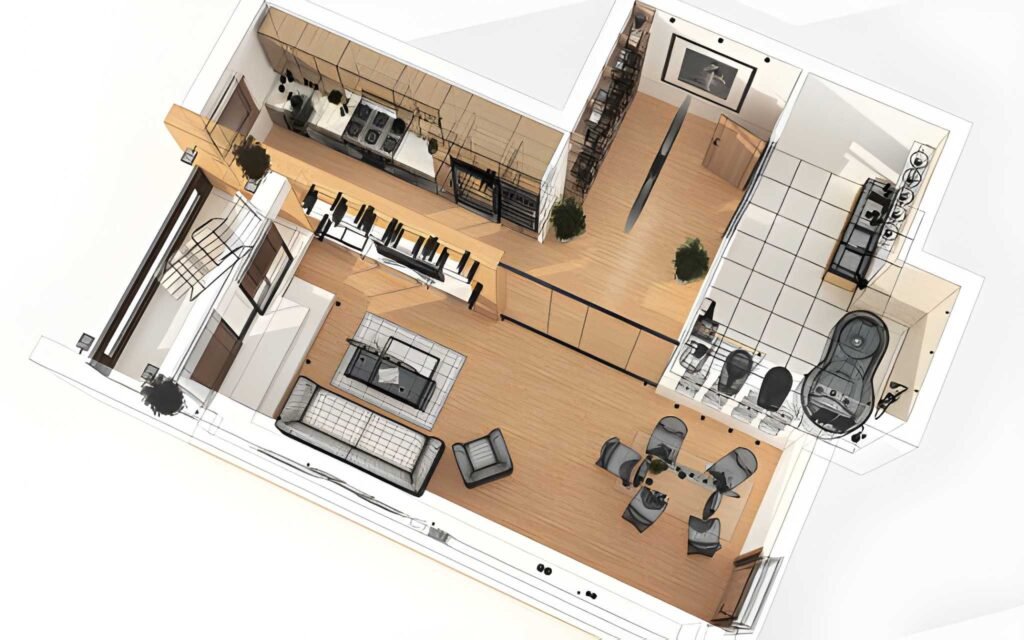
The traditional two-dimensional floor plan, with its static lines and symbolic fixtures, has long been the blueprint for retail design. Yet, it possesses a critical flaw: it requires the viewer to translate abstract geometry into a lived, volumetric experience. The emergence of accessible 3D floor planning technology has fundamentally altered this process, transforming retail design from an exercise in spatial accounting into a dynamic simulation of customer experience and operational flow. A 3D floor plan is more than a visual aid; it is an analytical tool that allows retailers, designers, and investors to prototype, stress-test, and perfect a space before a single physical change is made.
The most immediate advantage of a 3D visualization is its ability to communicate spatial relationships with intuitive clarity. Where a 2D drawing might show a 4-foot aisle between gondolas, a 3D model reveals what that aisle truly feels like. It can simulate the sightlines from the entrance, allowing a designer to ensure the cash wrap is visible but not imposing, and that key focal points draw the eye deep into the store. This is crucial for understanding density and clutter. A 2D plan might theoretically fit 12 clothing racks into a space, but a 3D model will instantly show if the resulting layout feels cramped and unwelcoming or abundant and engaging. This pre-emptive assessment prevents costly mistakes, such as ordering fixtures that overwhelm the space or creating customer flow patterns that lead to dead ends and frustration.
For stakeholder alignment, the value is immeasurable. A landlord can show a prospective tenant exactly how their concept will materialize within a vacant shell, making the space more tangible and desirable. A retail manager can walk through a virtual model with staff, planning for daily operations, identifying potential security blind spots, and discussing customer service strategies in a realistic context. Investors, who may not be trained to read architectural drawings, can gain an immediate and comprehensive understanding of the proposed layout, accelerating the approval process. The 3D model becomes a single, unambiguous source of truth that bridges the gap between technical design and practical business needs.
Beyond Visualization: The Functional Simulation of a 3D Plan
The utility of a 3D floor plan extends far beyond creating pretty pictures. It serves as a platform for rigorous functional analysis. Modern software allows for the integration of real-world metrics and dynamic elements.
One of the most powerful applications is lighting simulation. Designers can assign specific lumens and color temperatures to light fixtures within the model and observe how light falls across merchandise zones. They can identify dark corners that need accent lighting or glare spots that could discomfort customers. This data-driven approach ensures the lighting scheme is both atmospheric and functional, highlighting products effectively while creating a comfortable environment.
Furthermore, a 3D model can be used to choreograph the customer journey with unprecedented precision. By animating a virtual camera along a proposed path, a designer can experience the store exactly as a shopper would. They can assess the sequence of visual reveals—what a customer sees upon entering, what captures their attention next, and how they are naturally guided toward the point of sale. This “first-person shopper” perspective is invaluable for optimizing product placement, ensuring high-margin or promotional items are positioned for maximum impact, and creating a logical, intuitive flow that encourages exploration and increases dwell time.
The model also becomes a vital tool for planning operational logistics. The placement of the stockroom door, the clearance needed for rolling garment racks, the accessibility of the electrical panel, and the efficiency of the path from the stockroom to the sales floor can all be tested and refined in the virtual environment. This prevents the common real-world problem of a beautifully designed sales floor that is a nightmare to restock or maintain.
Table: 2D vs. 3D Floor Plan Capabilities for Retail
| Aspect | 2D Floor Plan | 3D Floor Plan & Model |
|---|---|---|
| Spatial Understanding | Provides abstract dimensions and fixture locations. | Creates an immersive sense of volume, scale, and proportion. |
| Customer Experience | Hypothesizes flow based on lines and arrows. | Simulates the actual visual journey and sightlines of a shopper. |
| Stakeholder Communication | Requires technical literacy to interpret. | Instantly understandable by clients, investors, and staff. |
| Error Identification | Relies on imagination to spot conflicts (e.g., a door that swings into a fixture). | Visually and obviously reveals spatial conflicts and design flaws. |
| Lighting & Atmosphere | Not applicable. | Allows for realistic simulation of lighting schemes, shadows, and ambiance. |
| Merchandising Planning | Shows where fixtures go. | Shows how products will look on fixtures and interact with light. |
From Model to Reality: The Iterative Design Process
The creation of a 3D retail floor plan is an iterative process that fosters collaboration and refinement. It begins with the accurate 2D base plan of the space. This outline is then extruded into a 3D model, incorporating real-world dimensions for ceiling height, columns, and doors. Next, a library of 3D objects is used to populate the space: clothing racks, shelving units, tables, mannequins, and the cash wrap. These are not generic blocks; they are accurate representations of the specific fixtures the retailer intends to use.
This is where the real magic happens. With the space populated, the design team can experiment with radically different layouts in minutes. What happens if we move the feature wall from the left to the right? How does the space feel with a centralized checkout versus a corner one? The ability to rapidly A/B test these scenarios saves thousands of dollars in physical trial and error. Materials can be applied virtually—testing different flooring, wall colors, and finishes to see how they interact with the lighting and the brand’s color palette.
In conclusion, a 3D floor plan is no longer a luxury in retail design; it is a fundamental component of a de-risked, strategic, and customer-centric approach. It transforms the design phase from a speculative drawing exercise into a proven simulation, ensuring that the final built environment is not only efficient and compliant but also emotionally resonant and commercially optimized. It is the crucial link between a concept on paper and a successful, functioning retail space, providing a confident answer to the most important question before construction begins: “Will this work?”