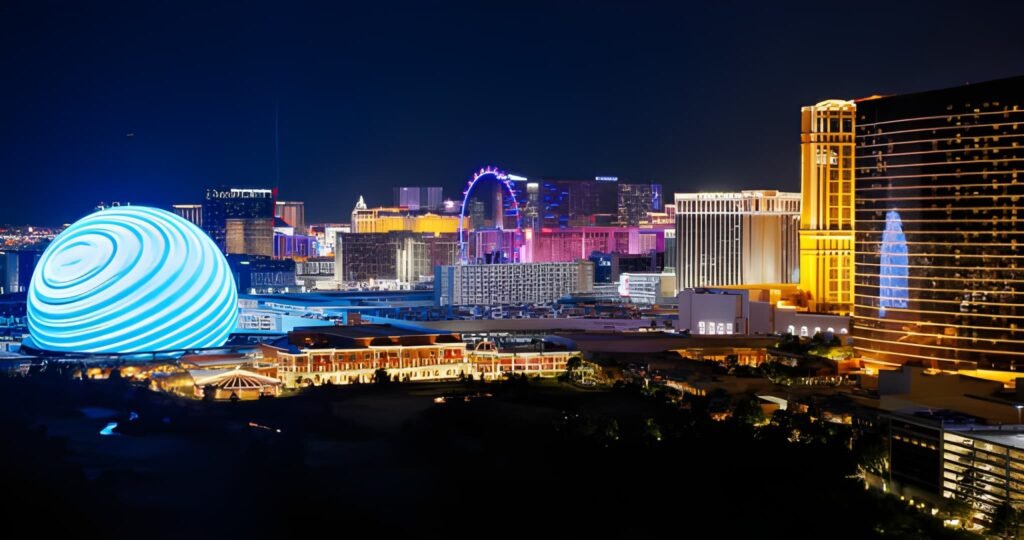
Las Vegas exists as a paradox. It is a city built on the shimmering, transient economy of tourism, yet it sustains a deep-rooted, diverse community of residents who call the desert home. Living here means disentangling the city’s identity as the “Entertainment Capital of the World” from its reality as a sprawling, sun-baked metropolis of neighborhoods, strip malls, and master-planned communities. It is a place of extreme climate, no state income tax, and a relentless cycle of boom and bust. This guide moves beyond the Strip to explore the tangible reality of building a life in a city that offers affordability, opportunity, and a unique 24-hour energy, all under the relentless Mojave sun.
The Two Cities: The Tourist Corridor and the Resident’s Vegas
To understand Las Vegas is to recognize its dual existence. The Las Vegas Strip is not actually within the city limits of Las Vegas; it resides in the unincorporated towns of Paradise and Winchester. This “Tourist Corridor” is a company town for hospitality giants like MGM Resorts and Caesars Entertainment. The resident’s Las Vegas is the vast valley of suburbs surrounding this core—Henderson, Summerlin, North Las Vegas, and the city of Las Vegas proper—where everyday life unfolds far from the blackjack tables and nightclubs.
The Nevada Advantage: Cost of Living in the Desert
Las Vegas’s primary financial draw is its lack of a state income tax, providing an immediate boost to take-home pay. Combined with historically affordable housing, it has long been a magnet for those seeking a lower cost of living. However, rapid growth and inflation have eroded some of this advantage, particularly in the housing market. The trade-off comes in the form of higher-than-average insurance costs and utility bills to combat the extreme heat.
A detailed monthly budget for a professional living in a one-bedroom apartment in a desirable area like Summerlin or Green Valley (Henderson) illustrates the balance:
- Rent: $1,500 – $1,800
- Utilities (Electricity – AC is critical): $200 – $400 (summer peak)
- Water/Sewer/Trash: $80 – $120
- Internet: $80
- Groceries: $400
- Gasoline & Car Maintenance: $300 (a car is absolutely essential)
- Dining & Entertainment: $500 (taking advantage of local deals)
This puts a baseline monthly expenditure between $3,060 and $3,600, not including savings or healthcare. The massive swing in summer electricity costs is a fundamental part of financial planning.
The Hospitality Engine: Job Market and Career Opportunities
The tourism and hospitality industry is the undeniable heart of the Las Vegas economy, but the city has made concerted efforts to diversify.
- Hospitality & Conventions: This sector employs a massive portion of the workforce. Jobs range from dealers, servers, and hotel staff to corporate roles in marketing, finance, and management for the major casino resorts. The convention industry is also a huge employer, making the city a year-round destination.
- Construction & Real Estate: As one of the fastest-growing cities in the U.S., construction is a perpetual industry. Boom times see a frenzy of building, though it is highly susceptible to economic downturns, as seen in the 2008 crash.
- Healthcare: The growing and aging population has spurred a massive healthcare industry. HCA Healthcare and Universal Health Services operate large hospital networks, and the Cleveland Clinic Lou Ruvo Center for Brain Health is a world-renowned facility.
- Technology & Logistics: A growing tech sector is emerging, focused on cybersecurity and data centers, benefiting from low energy costs and dry air. The city’s central Western location also makes it a growing logistics and distribution hub for companies like Amazon.
While many jobs are in hospitality, the presence of corporate headquarters for the major casino companies provides a layer of high-paying, stable professional jobs.
A City of Master-Plans: Finding Your Neighborhood Oasis
Las Vegas is a city of planned communities. Life is organized around these suburban villages, each with their own shopping centers, parks, and HOAs.
- Summerlin: Located on the western edge of the valley against the Red Rock Canyon National Conservation Area, this is the epitome of upscale Las Vegas suburban living. It features numerous villages with distinct personalities, top-rated schools, extensive trail systems, and a sense of community. It is clean, safe, and highly desirable for families and professionals.
- Henderson: The second-largest city in Nevada, directly southeast of Las Vegas. Green Valley is its most established and sought-after area, offering a similar vibe to Summerlin with excellent amenities and schools. Henderson has its own vibrant downtown district and a more mature, settled feel.
- Spring Valley: A centrally located, unincorporated area west of the Strip. It is a mixed bag of older and newer housing, offering more affordability and diversity than the master-planned communities, with fantastic access to Chinatown’s incredible dining scene.
- Downtown Las Vegas (& Arts District): A world away from the Strip. The Fremont Street Experience draws tourists, but the surrounding areas, particularly the 18b Arts District, are evolving into a hub for local artists, breweries, and quirky boutiques. It attracts a more creative, urban-minded demographic.
- Southwest Las Vegas: Areas like Mountains Edge and Southern Highlands are newer master-planned communities that offer modern homes and amenities, appealing to families looking for newer construction slightly further out.
- North Las Vegas: Once considered a less desirable area, it has seen significant investment and growth, offering some of the most affordable new construction homes in the valley. It is popular with first-time homebuyers and military families from nearby Nellis Air Force Base.
The Desert Calculation: Renting vs. Buying
The Las Vegas housing market is famously volatile, characterized by extreme boom and bust cycles. The decision to rent or buy requires careful consideration of market timing and personal stability.
The Case for Renting: Renting offers crucial flexibility in an economy tied to tourism, which can be sensitive to economic recessions. It also frees residents from the burden of high AC repair costs and exterior maintenance in the harsh desert sun. For newcomers, renting allows time to understand the vastness of the valley and choose a community wisely.
The Case for Buying: For those with secure employment and a commitment to stay 5+ years, buying can be a path to building equity and locking in housing costs. The lack of state income tax can make qualifying for a mortgage easier. However, buyers must be prepared for the market’s potential volatility.
A Simplified Financial Comparison:
Consider a $400,000 home in Henderson.
- Renting: Monthly rent for a similar property: ~$2,100. This is a pure expense.
- Buying:
- Down Payment (20%): $80,000
- Mortgage Principal & Interest (30-year fixed at 7%): ~$2,130/month
- Property Taxes (Clark County, effective rate ~0.65%): \frac{0.65}{100} \times 400,000 = \$2,600 per year, or ~$217/month
- Homeowners Insurance: ~$100/month
- Total Monthly Cost (P&I + Taxes + Insurance): ~$2,447
This calculation shows that buying can be competitive with renting from a cash-flow perspective. The principal portion of the mortgage payment builds equity, but this must be weighed against the risk of a market correction and the responsibility of maintenance in a demanding climate.
The Housing Market: Stucco, Tile Roofs, and New Construction
Las Vegas’s housing stock is overwhelmingly modern, dominated by stucco homes with tile roofs built after 1990.
Average Home Prices: The median home price in the Las Vegas valley is volatile but typically ranges between $400,000 and $450,000.
Most Affordable Areas to Buy a Home: The most affordable options are typically found in North Las Vegas and in older neighborhoods in the east Las Vegas valley, near Nellis Air Force Base.
Luxury Real Estate Hotspots: The luxury market is concentrated in:
- The Ridges & Southern Highlands: Ultra-luxury custom homes in guard-gated communities with stunning views of the Strip and the valley.
- MacDonald Highlands (Henderson): A prestigious community with custom estates and a private golf course.
- Summerlin: Specific villages within Summerlin, such as The Cliffs, feature multi-million dollar homes.
Rental Market: The market is strong, driven by tourism industry workers and newcomers. Expect to pay:
- 1-Bed Apartment: $1,300 – $1,800+
- 3-Bed Single-Family Home: $2,000 – $2,800+
Investing in the Boom/Bust Cycle: Real Estate Investment and Growth
Las Vegas real estate is not for the faint of heart. It offers high potential rewards but carries significant risk.
- Best Places to Invest: Areas with strong rental demand from stable employment bases, such as near Nellis Air Force Base or in well-established parts of Henderson and Summerlin.
- Future Growth Neighborhoods: The far southwestern and northwestern edges of the valley, towards the town of Blue Diamond and the Skye Canyon master-plan, are seeing new development as the city continues to expand outward.
The Commute: The Almighty Freeway and a Car-Centric Existence
Las Vegas is a city designed for the automobile. Public transportation is an afterthought for most residents.
- The Car: This is an absolute necessity. The valley is vast, and walking is impractical due to distance and heat. The freeway system (I-15 north-south, US-95 east-west, and the 215 Beltway) is the lifeblood of the city, and traffic, while not as severe as coastal cities, can be heavy during rush hour.
- Public Transit: The RTC bus system provides coverage, but it is slow and not comprehensive. There is a monorail that runs behind the Strip, but it is primarily for tourists moving between casinos.
Life in the Desert: Culture, Heat, and Local Secrets
Resident life in Las Vegas has little to do with the Strip. The local culture is family-oriented, outdoor-focused during the cooler months, and centered around community amenities.
- The Outdoor Lifestyle: The proximity to world-class natural attractions is a major perk. Red Rock Canyon, Valley of Fire State Park, and Lake Mead offer hiking, climbing, and boating just minutes from the city. The winter and spring months are perfect for exploring.
- The Food Scene: Beyond the celebrity chef restaurants on the Strip lies an incredible local food scene. The city has one of the nation’s best Chinatown districts, fantastic Mexican food, and a thriving community of off-Strip chef-owned restaurants that rival any major city.
- The Arts & Culture: The Smith Center for the Performing Arts hosts Broadway tours, concerts, and the Las Vegas Philharmonic. The Downtown Arts District holds a popular First Friday festival. The Neon Museum offers a fascinating look at the city’s history.
- The “24/7” Vibe: The city’s round-the-clock energy trickles down to residents. It’s not uncommon to find grocery stores, gyms, and restaurants open all night, offering a convenience found in few other places.
The Family Equation: Schools, Safety, and Suburbs
The quest for top-rated schools is the primary driver for families to choose specific master-planned communities.
- Best Schools & Universities: The Clark County School District (CCSD) is one of the largest in the nation and suffers from overcrowding and inconsistent performance. The highest-rated public schools are almost exclusively located in Summerlin and Henderson. There are also many charter school options. For higher education, the University of Nevada, Las Vegas (UNLV) is a growing R1 research university, and Nevada State University in Henderson is expanding rapidly.
- Raising a Family & Safety: Safety is closely tied to neighborhood. The master-planned communities of Summerlin and Henderson consistently report very low crime rates and are designed with families in mind, featuring parks, pools, and community centers. Crime rates are higher in the older parts of the city and the corridor immediately surrounding the Strip.
The Practicalities: Extreme Heat, Healthcare, and Relocation
- Weather and Climate: Las Vegas has a hot desert climate. Summers are brutally hot and dry, with temperatures consistently exceeding 100°F from June through September, often reaching 115°F. Winters are mild and sunny, with daytime temperatures in the 50s and 60s. It receives minimal rainfall.
- Healthcare: The city is a major healthcare hub for the region. Sunrise Hospital & Medical Center, University Medical Center (UMC), and St. Rose Dominican Hospitals operate large networks. The Cleveland Clinic presence has elevated the standard of care.
- Relocation Checklist:
- Secure Reliable Transportation: A well-maintained, air-conditioned car is non-negotiable.
- Prioritize AC and Insulation: When choosing a home, the age and efficiency of the AC unit and the quality of insulation are critical.
- Hydrate Constantly: The dry heat dehydrates you quickly. Always carry water.
- Get Off the Strip: Make a conscious effort to explore local neighborhoods, restaurants, and parks to find the real Las Vegas.
- Prepare for Wind: The spring can bring intense windstorms that whip up dust and can cause damage.
Las Vegas is a city of extremes and opportunity. It offers a lifestyle that can be whatever you make of it—a quiet family life in a sunny suburb, a 24-hour hustle in the hospitality industry, or a creative pursuit in a city that is constantly reinventing itself. Living here requires a tolerance for heat, an understanding of economic cycles, and a willingness to look beyond the glitter to find the genuine community that thrives in its shadow. For those who do, the rewards are sunshine, affordability, and a unique energy found nowhere else on earth.